
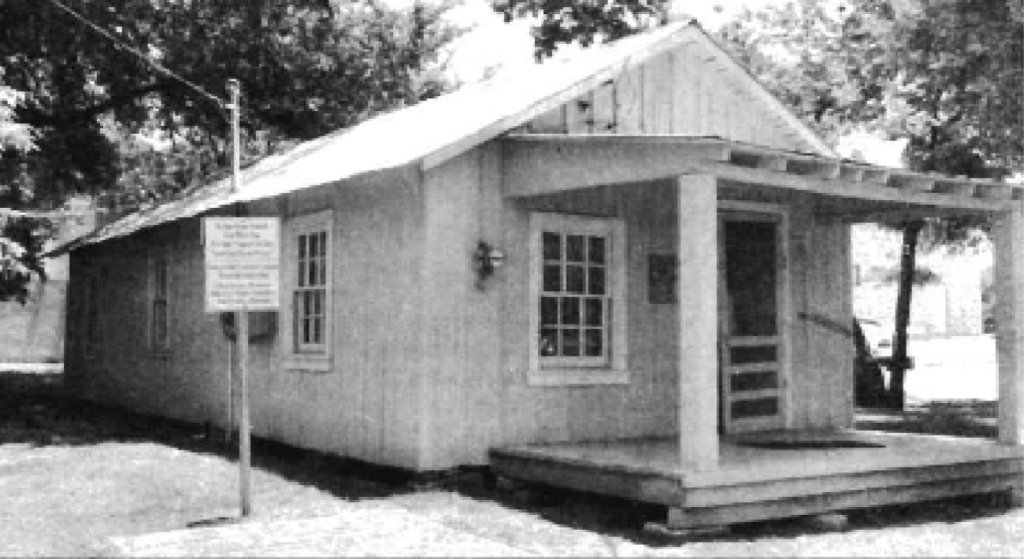
The plan is to develop a series of Shotgun House living history museums in every county in the Mississippi Delta. The house will be the attraction with a showcase of life as it was once lived by its inhabitants around the turn of the century.
This recreation of a shotgun house typifies early 20th century urban workers’ dwellings throughout the South. Usually one room wide and three rooms deep, there would have been a living room, then a bedroom and finally a kitchen. The shotgun house was inexpensive to build and occupied a small amount of land. The name of this style of house is derived from an African word “to-gun” meaning a place of assembly. Folk etymology, however, attributes the name to the fact that you could shoot a shotgun straight through the house because of its arrangement.
What is common to all shotgun houses is the lack of an interior hallway; the rooms open one into another via doors, saving interior space.
THE SITE, THE PEOPLE, THE CULTURE
Where Mound Bayou, Mississippi intersects with the blues highway (HWY 61) is prime cotton land. Two ex-slaves from Davis Bend, Warren County, Mississippi, founded mound Bayou on July 12, 1887. Isaiah T. Montgomery and Benjamin T. Green led the migration from Davis Bend. They, along with others, purchased land from the Louisville, New Orleans, and Texas Railway (L.N.O.T.) Company. Mound Bayou was a land of promise for African Americans. Self-help, race pride, economic opportunity, and social justice were encapsulated in this “promise.” It was a self-segregated community that fostered self-governance. Early on, Mound Bayou had a railway station, post office, cemetery, bank, six churches, historic homes, retail stores, and several schools. Its economy depended heavily on the production of cotton, timber, and corn. Politically, co-founder and mayor, Isaiah T. Montgomery and Charles Banks worked with Booker T. Washington to maintain the growth of Mound Bayou. President Theodore Roosevelt visited Mound Bayou and called it the “Jewel of the Delta”… the key example of prosperity in the Mississippi Delta.
From 1907 to 1915, the cotton industry and the railroad center allowed Mound Bayou to flourish grow. The 3,500 people currently living in and around the city of Mound Bayou are very aware of their glorious past and are currently exploring ways to reinvigorate their community and forge a new empire, to honor the “Cotton as King” era. Too much of their story is unknown to most people in the South and throughout America. The proposed site of the Cotton Pickers of America Monument and Sharecroppers Interpretive Center is located just outside the city limits. Thus, visitors to the Monument will have the opportunity to tour this historic city.
EDUCATIONAL OPPORTUNITIES
The educational opportunities are endless. Embedded in the Monument design are story boards, plaques, oral history narratives and stimulating visual images that capture the essential interpretations of the South, during this era in American history. As outlined in the attached design concept, visitors to the Cotton Pickers of America Monument and Sharecroppers Interpretive Center will be welcomed to a Central Plaza lined in Legacy Bricks that lead to the iconic sculptural remembrance of an enslaved family, in typical clothing for picking cotton: a tribute to the enslaved laborers and sharecroppers. We expect that students of all ages will be impacted by these images and be spurred to explore the entire Center in search of their relationship to these experiences.
The Center will serve as a magnet, drawing students and faculty from schools and colleges/universities from around the country to visit and conduct research concerning economic disparity. It will be located near several institutions of higher learning in this regard, namely Delta State University, Mississippi Valley State University, Alcorn State University Extension and Demonstration Farm, Mississippi State University Agricultural Research Facility, Mississippi Delta Community College, and Coahoma Community College.
Relative to academic citizenship, the Center will provide avenues for middle, high school, and college students to participate in community service learning associated with educational advancement and economic development. College students will be paired with younger students to work on scientific projects related to the modernization of cotton manufacturing and agriculture. The Center will bridge these experiences for students between the arts and sciences, and enhance the overall educational development for lifelong learning, and appreciation of African American heritage as seen through the dimensions of the cotton industry.
Khafre Inc staff will work with public/private/home schools and university professors to generate curriculum that is appropriate for their respective students. A virtual site will also be developed to accommodate distance-learning capabilities.